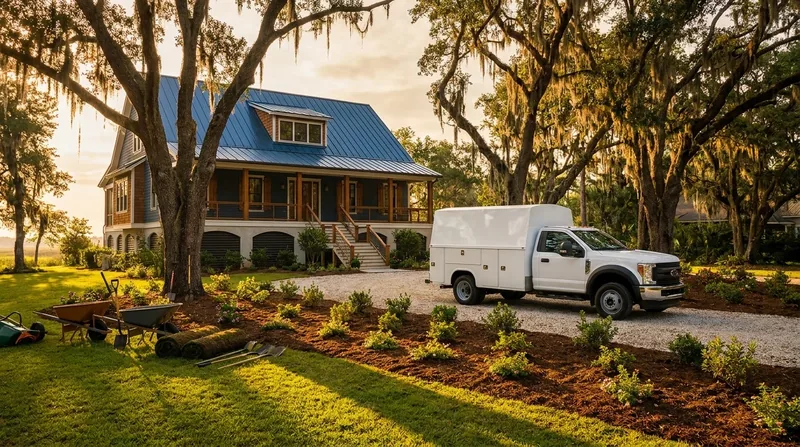
How to Start a Landscaping Business in South Carolina: When You Need a Clemson Pesticide License
How to Start a Landscaping Business in South Carolina: When You Need a Clemson Pesticide License
If you are searching for a landscaping license in South Carolina, the short answer is that the state does not issue one. South Carolina has no state landscaping license and no state lawn care license. What you do need depends on what your crew does, what you sell, and where you work. For most new owners, the checklist is a state business filing, a local business license, tax registration if you sell taxable goods, and a Clemson pesticide applicator license if you apply pesticides to other people's property for pay. This guide puts those requirements in the order you will meet them, with the fees and deadlines the agencies publish.
The steps themselves are not hard, but a few catch new landscapers off guard. The pesticide license and the irrigation rules cause the most confusion, so they get the most attention below.
What You Need Before You Start
Gather these items before you open a state filing portal. Each takes a few minutes to get, but a missing item can stall a filing for days.
- The business name you want, checked against the state business search
- A South Carolina street address for your registered agent. This can be your own address if you are a South Carolina resident individual, or the address of a registered agent service
- Your business address, plus the county and city where the business is located
- A list of the equipment and vehicles you will use, which your insurance agent will ask for
- A list of every pesticide and herbicide product you plan to apply, with the product label for each
- A payment method for filing fees
- Insurance quotes for general liability and commercial auto, and workers' compensation if you plan to hire employees
Fees and Deadlines at a Glance
The table below lists the costs covered in this guide. Fees for items not listed here, such as local business licenses and exam registration, are set by the issuing agency, so confirm them directly before you budget.
| Item | Cost | Issued by | Notes |
|---|---|---|---|
| Articles of Organization for an LLC | $110 filing fee | SC Secretary of State | Filed online through Business Entities Online, returned in 24 to 48 business hours |
| Name reservation | $25 | SC Secretary of State | Holds the name for 120 days, nonrenewable |
| Retail License | $50 one time, per location | SC Department of Revenue | Needed only if you sell tangible goods such as mulch, plants or stone |
| Clemson commercial applicator license | $50 new license fee | Clemson Department of Pesticide Regulation | Requires core and category exams and proof of financial responsibility |
| Hilton Head Island irrigation installer trade certificate | $25 initial, $10 renewal | Town of Hilton Head Island | Renewal due by Dec 31 |
| Local business license | Set by your city or county | City or county | Confirm with your local office before you budget |
| Annual report for a standard LLC | None | SC Secretary of State | Not required for an LLC not taxed as a corporation |
Step 1: Confirm the State Rules, Then Check Your Local Rules
Start by accepting that the state will not hand you a landscaping license. That also means no state license number to put on your truck or website. Your real requirements come from three places: the Secretary of State for your entity, the Department of Revenue for taxes, and your city or county for the local business license. The Clemson pesticide license is a separate state requirement that applies only if you apply certain pesticides for pay. The steps below cover each one.
Before you go further, decide what services you will sell in year one. Mowing, edging, mulching and planting carry a very different set of requirements from weed control, fertilizer programs and insect treatments. Your service list determines whether you need Step 8.
Step 2: Choose Your Legal Structure
Most small landscaping companies choose between a sole proprietorship and a limited liability company. A sole proprietorship has no state formation filing. Sole proprietors and general partnerships do not file organizing documents with the Secretary of State at all. An LLC is a formal entity, and you file Articles of Organization for a Domestic Limited Liability Company under S.C. Code Section 33-44-203. The filing fee is $110.
A corporation costs $135 to form ($110 plus the $25 minimum License Fee), its articles must be signed by a South Carolina attorney, and it adds steps. You file Articles of Incorporation for a Domestic Business Corporation under S.C. Code Section 33-2-102, along with Form CL-1 and its one-time $25 initial License Fee, and that Form CL-1 is due within 60 days of doing business or using capital in South Carolina. Corporations also file an annual report with the corporate income tax return. A corporation pays 5% of South Carolina taxable income, plus the annual License Fee.
An LLC not taxed as a corporation is not required to file an annual report or pay the corporate License Fee. Choosing between these structures involves tax and liability questions that depend on your situation, so talk with a CPA and an attorney before you decide. This article is not tax advice.
Step 3: Check and Reserve Your Business Name
An LLC name must include the words limited liability company or limited company, or an abbreviation such as LLC, L.L.C., LC or L.C. Under S.C. Code Section 33-44-105, the name must also be distinguishable from other registered entity names and from reserved or registered names on the Secretary of State's records. Search the name at the Secretary of State business search before you commit to it. A near-match, such as a name that differs by one word, can be rejected.
If you need time to finish the paperwork, reserve the name for $25. The reservation lasts 120 days and cannot be renewed, so plan to file the formation document inside that window. If you want to use a name that is indistinguishable from an existing one, you can file written consent from the other entity or an Application for Use of an Indistinguishable Name, which carries a $10 fee.
Step 4: File Your Formation Document and Name a Registered Agent
File your formation document through Business Entities Online, the Secretary of State's filing portal. Online filings are returned within 24 to 48 business hours. The Secretary of State does not publish a separate expedited tier, so online filing is the fastest path available. Mailed and in-person filings take longer, and the agency does not publish a mail turnaround window.
Every LLC must designate and continuously maintain a registered agent with a street address in South Carolina, under S.C. Code Section 33-44-108. The agent must be an individual South Carolina resident, a domestic corporation, another LLC, or a foreign corporation or company authorized to do business in the state. The agent's name and address must appear on the formation document. If you later change agents, file a statement of change with the Secretary of State. Missing a registered agent is an easy mistake that creates problems when a customer or vendor tries to serve papers.
Step 5: Record a DBA Locally
Many landscapers operate under a shorter brand name, such as Green Edge Lawn Care or Summit Outdoor Services, rather than their legal name. South Carolina has no state-level DBA registration. The Secretary of State states that its office does not register DBA or trade names. Instead, there is no separate DBA filing: list the trade name on your local business license. List the trade name on your IRS EIN application and on your SCDOR Business Tax Application as well. Check the South Carolina Business One Stop DBA guidance for the current process.
Step 6: Register for Taxes and Get a Retail License If You Sell Goods
Get a federal Employer Identification Number from the IRS before you open a bank account or hire anyone. The EIN is free when you apply directly through the IRS. Then register your business through the Business Tax Application on MyDORWAY at the South Carolina Department of Revenue.
If you sell tangible goods, such as mulch, bagged soil, plants, stone or pavers, you need a Retail License from the SCDOR. The license is a one-time, nonrefundable $50 fee per location. The state sales tax rate is 6%. Whether a specific sale is taxable depends on how you bill it, so ask the SCDOR or a CPA how your invoices should show materials and labor. Pure labor services are handled differently from sales of goods.
Step 7: Get Your Local Business License
South Carolina has no general statewide business license. Registration with the Secretary of State does not count as a business license. Most cities levy business license taxes, and only nine counties do: Beaufort, Charleston, Dorchester, Horry, Jasper, Marion, Orangeburg, Richland and Sumter. Every city and county that levies the tax uses a May 1 to April 30 license year, and the license is due April 30. Renewals are handled at localblrenewal.com.
Your license is tied to the place where the business is located. If your office or equipment yard is in one city and you work across a county line, check whether each jurisdiction you work from requires its own license. Your city or county office can tell you the fee and the application steps, because those figures are set locally and are not listed here.
Step 8: Decide Whether You Need a Clemson Pesticide Applicator License
This is the requirement that matters most for landscapers, and it is the one most often missed. The Clemson Department of Pesticide Regulation requires a commercial applicator license for two situations. The first is anyone who applies restricted-use pesticides. The second is anyone who applies any pesticide in Category 3 (ornamental and turf) on another person's property for pay. If your crew applies weed killer to customers' lawns, treats ornamental shrubs for insects, or applies turf fungicides, you fall under the second rule.
To get the license, you pass the core exam and the category exam for the category you will work in, pay the $50 new license fee, and meet the financial responsibility requirement. That requirement is $50,000 per claim with a $100,000 annual aggregate. The Department does not accept insurance binders for this purpose, so ask your insurance agent for the specific proof form the Department accepts before you apply. Exam registration, study materials and renewal details come from Clemson, so confirm them there rather than relying on secondhand figures.
If you already hold a commercial applicator license from another state, check whether reciprocity applies. Clemson offers reciprocal licenses with 13 states. Your home state's license and the South Carolina requirements will each have their own conditions, so confirm the details with Clemson before you assume a transfer.
If your crew only mows, edges, mulches, prunes and plants, you may not need the pesticide license. That is a judgment about your service list, not a blanket rule, so confirm it with Clemson before you add any lawn treatment to your menu.
Step 9: Check Irrigation Rules Before You Install Anything
Irrigation is where local rules matter most. Hilton Head Island requires a town irrigation installer trade certificate. The initial certificate costs $25 and the renewal costs $10, and renewals are due by Dec 31. If you install or repair irrigation systems there, obtain the certificate before you bid the job.
Outside Hilton Head Island, confirm the rules before you install a system. Ask your county or municipal building department whether an irrigation permit or license applies in your jurisdiction. You can also ask the South Carolina Department of Labor, Licensing and Regulation (LLR), which oversees many contractor licenses, whether a state-level license applies to your work. Do not assume either answer from a neighbor's experience.
Step 10: Check Hardscape, Masonry and Contractor Thresholds
Patios, walkways, retaining walls and outdoor kitchens sit at the edge of contractor licensing. Commercial contractor licensing starts at projects above $10,000. Residential specialty registration applies to residential work above $500. A hardscape, masonry or retaining wall project over $500 on a home may require Residential Builders Commission (RBC) registration if masons do the work, or a builder license if you manage the project as a builder.
Map your planned hardscape work against those thresholds before you quote. A $600 retaining wall and a $9,000 patio can fall under different rules, and a crew that quotes first and checks later often ends up rebidding. Confirm your exact category with LLR or the RBC.
Step 11: Put Insurance in Place Before Your First Job
Insurance is not a state license, but customers, property managers and the Clemson pesticide license will all ask for it. Start with general liability and commercial auto coverage. Add workers' compensation if you hire employees, and confirm the requirement with a licensed insurance agent or the SC Workers' Compensation Commission. Ask any agent to quote coverage that meets the Clemson financial responsibility requirement if you will apply pesticides, and get the proof in the form the Department accepts. Coverage limits and premiums vary widely, so get several quotes rather than estimating from another business's numbers.
Expected Results
When these steps are complete, you may be able to form the business, open accounts, invoice customers and bid on the services your license covers. If you complete the Clemson license, it may also allow you to offer pesticide and turf treatment work that many customers buy as a package. Your results will depend on your market, your pricing, your crew and how well you follow the rules that apply to each service. Plan your timeline around the Secretary of State filing window, the Clemson exam schedule and your local license year, because those are the steps most likely to set your start date.
Tips for Getting It Right
- Build your service list first, then check each service against Step 8 and Step 10 before you advertise it
- Put the registered agent address and the DBA on the same checklist, so the name on your truck matches the name on your filings
- Calendar April 30 if you hold any local business license, and calendar the Dec 31 renewal if you work on Hilton Head Island
- Keep copies of your insurance proof, Clemson license and local license in the truck, and digital copies in your office
- Ask Clemson and your insurance agent to confirm the proof form before you file, not after
Common Mistakes to Avoid
- Assuming there is a state landscaping license, then skipping the questions that do apply to your business
- Spraying a customer's lawn with a Category 3 product before the Clemson license is issued
- Submitting an insurance binder where the Department requires a different proof of coverage
- Treating a DBA as a state filing, when the trade name simply goes on your local business license and tax records
- Filing an LLC name that is too close to an existing registered name, which the Secretary of State can reject
- Letting the name reservation expire before the formation document is filed
- Quoting hardscape or irrigation work before you confirm the license or registration threshold
- Mixing personal and business accounts, which makes your tax and liability position harder to defend
This article is informational only. It is not legal, tax, insurance or licensing advice. Requirements, fees and deadlines change, and the agencies named here make the final determination for your business. Confirm current rules with the Secretary of State, the Department of Revenue, Clemson, your city or county, and LLR, and consult a qualified attorney or CPA before you choose a legal structure or make tax decisions.
Official resources: South Carolina Secretary of State, Business Entities, South Carolina Department of Revenue, and South Carolina Small Business Development Centers, which can help with planning questions at no cost.
Keep exploring: related South Carolina guides
- How to Start a Junk Removal Business in South Carolina
- How to Start a Lawn Care Business in South Carolina
- How to Start a Cleaning Business in South Carolina
- How to Start a Pest Control Business in South Carolina
- How to Get a Contractor License in South Carolina
- How to Start an LLC in South Carolina
- South Carolina Business License
- How Much Does It Cost to Start a Business in South Carolina
- All South Carolina business types
- Every South Carolina guide in one place